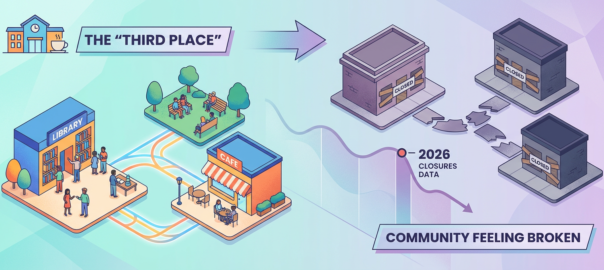
You’ve Noticed It, Even If You Haven’t Named It
Something shifted in your neighborhood, and you can’t quite put your finger on it. The coffee shop where people used to linger for hours closed last spring. The library’s community room sits empty most evenings. That bar where everyone knew everyone’s name turned into a franchise location. You find yourself going home after work, scrolling through your phone, feeling oddly disconnected from people who live three houses down.
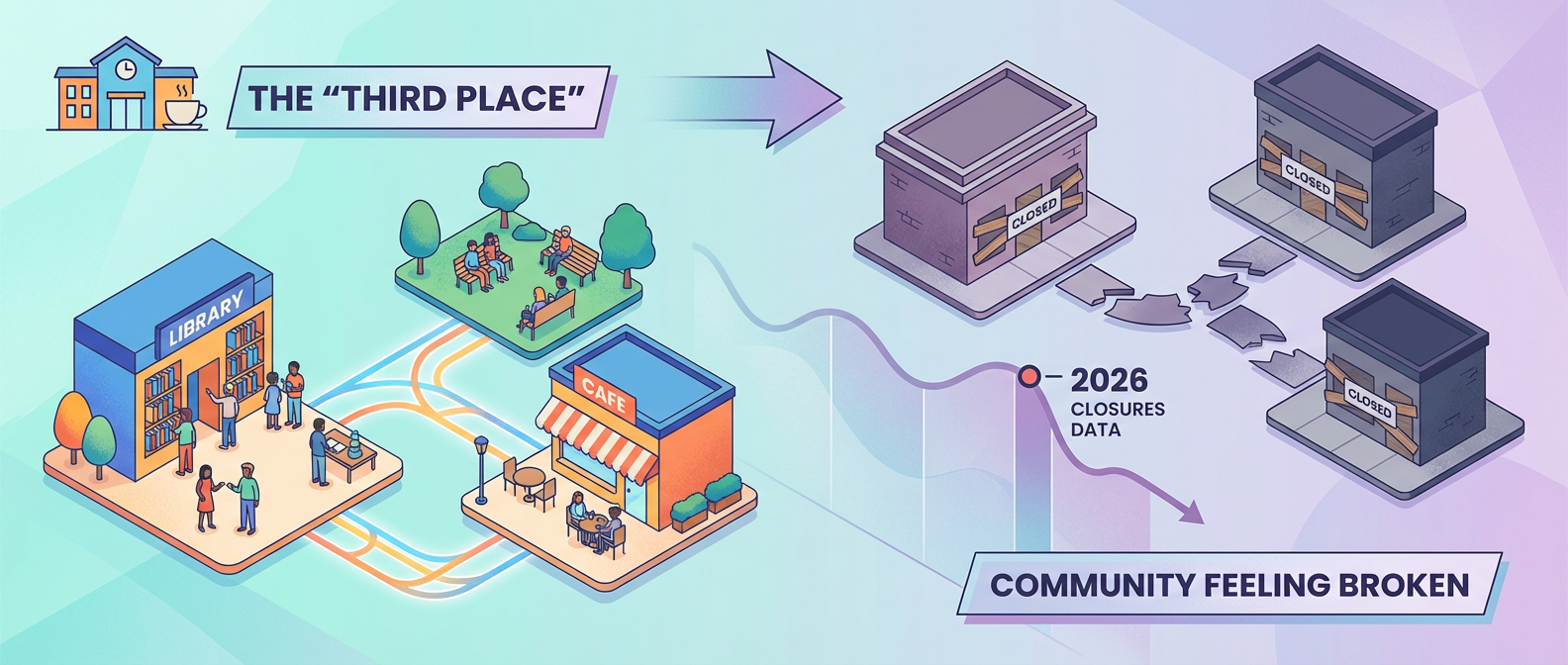
This isn’t just nostalgia. This is the collapse of what urban sociologist Ray Oldenburg called “the third place” — those casual public spaces between home and work where real community happens. And the data from 2024 and 2025 is alarming enough that city planners and community organizers are finally treating it as a crisis worth solving.
Here’s what’s real: only 22% of Americans now visit a non-home, non-work social space on a weekly basis. That’s down from 41% in 2000. In suburban communities especially, people report having no close friends at a rate that has quadrupled since 1990. The loneliness isn’t accidental. It’s structural. And understanding why is the first step toward actually doing something about it.
Why the Numbers Broke — And They Broke Fast
The independent coffee shop is a useful canary in the coal mine. In 2024 alone, independent coffee shops closed faster than they opened for the third year running. The math is simple and brutal: commercial rent has climbed an average of 18% since 2022. That’s not a gradual drift. That’s an avalanche. A small business owner who was managing at 2022 rent levels suddenly faces a choice between raising prices, cutting hours, or closing the door.
Coffee shops, dive bars, bookstores, community centers, gyms where people actually talked to each other — these weren’t gold mines. They were modest operations that worked when the economics made sense. When landlords realized they could extract more value by replacing a $1,500-a-month community gathering spot with a cell phone kiosk or rotating pop-up, they did. The third place didn’t survive on sentiment. It survived on thin margins. And those margins evaporated.
The U.S. Surgeon General Advisory on Loneliness and Isolation connected these dots explicitly: as physical gathering spaces contracted, social isolation spiked. People didn’t spontaneously decide to stay home more. They stayed home because there was nowhere accessible to go. The pathways to casual friendship — bumping into the same person at the coffee counter, joining a book club that met Thursdays at the library, becoming a regular anywhere — those pathways were systematically eliminated by market forces nobody voted for.
Your Town’s Score Might Be Lower Than You Think
The Project for Public Spaces released their 2025 Placemaking Index, and the findings were sobering. Out of hundreds of American cities evaluated, only 11 scored high enough to have what researchers called “healthy third place ecosystems.” Most mid-sized cities — the towns and suburbs where most Americans actually live — scored below 40 out of 100. That’s not just poor. That’s broken.
What does a score below 40 look like in practice? It means few places where strangers naturally become acquaintances. Parks that exist but feel unsafe or unwelcoming. Restaurants and cafes where you’re expected to consume and leave, not linger. Libraries that cut evening and weekend hours because of budget pressure. A town where you can live for years and never develop a genuine sense of belonging, never make a single friend rooted in your actual neighborhood.
You can check your city’s score yourself through the Project for Public Spaces Placemaking Resources. Once you know where your community stands, the next question becomes: what actually works to fix this? That’s where the good news starts to show up.
What Actually Works — And What’s Happening Right Now
A handful of cities stopped waiting for the free market to solve this and started treating third place infrastructure like the public good it actually is. Tempe, Arizona and Raleigh, North Carolina ran a pilot program in 2025 that seems almost too simple to work. They created “Third Place Activation Grants” — direct funding of $5,000 to $25,000 given to small community venues like independent coffee shops, bookstores, community centers, and local bars to help offset commercial rent and stay open.
The results? Eighty-seven percent of grant recipients in Tempe were still operating 12 months later. That’s not a home run in traditional business terms. But it’s a home run in terms of keeping spaces alive where humans can gather casually and build actual relationships. The cost per venue was measured in thousands. The return was neighborhoods where people felt connected again.
Other cities are experimenting with different solutions. Some are offering property tax breaks or zoning changes that make it easier to operate modest gathering spaces. Some are protecting ground-floor retail from conversion to office or residential use. Some are funding community programming in existing parks and libraries to make them feel active and welcoming during off-peak hours. One solution doesn’t work everywhere. But doing nothing is no longer the default.
What You Can Actually Do Monday Morning
You don’t need to wait for your city council to act, though pushing them matters too. Start by identifying what third places still exist in your neighborhood — and I mean really identifying them, not assuming. Is there a park with actual programming? A library with regular events? A café that seems to have regulars? A community garden? A local bar or restaurant where people seem to know each other? Visit one. More than once. Become a regular. Bring someone else.
Talk to the owners of small gathering spaces about what would actually help them survive. Rent pressure is real, but so is the fact that people often don’t know these spaces exist. Loyalty programs, volunteer community events, word-of-mouth campaigns — these things cost almost nothing and they matter. If you find a third place worth saving, save it the most direct way: show up, spend money there, tell other people to do the same.
Then move to the harder work. Read your city council minutes. Attend zoning board meetings. Ask questions about commercial rent, about ground-floor retail, about how the city actively supports community gathering spaces. You’ll probably find that nobody on the city council has thought about third places as a policy question. That’s your opening. Communities that treat third place infrastructure as a priority — the way they treat roads and police and water — actually maintain those spaces.
Your town’s brokenness isn’t inevitable. It’s not generational entropy. It’s a policy failure happening in real time, which means it’s also a policy problem that can be solved. Start by naming it. Then start showing up. Let me know what you find in your neighborhood.